
 By
By 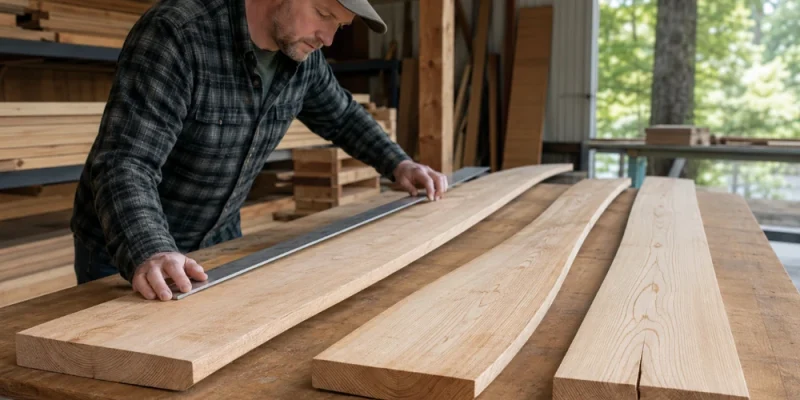
A board may look straight when you buy it, then develop a curve or crack after you bring it home. This can be frustrating, especially when the lumber was selected for shelves, furniture, framing, or another project that needs straight pieces.
In many cases, the change happens because wood continues reacting to its environment after it has been cut and dried. Understanding how moisture, grain, storage, and temperature affect lumber can help you choose and handle boards more carefully.
Wood Continues to Absorb and Release Moisture
Wood is a natural material with tiny cells that hold moisture. Even after lumber has been dried, it continues to absorb moisture from humid air and release moisture when the surrounding air becomes dry.
When a board gains moisture, it expands. When it loses moisture, it shrinks. The movement is usually greater across the width and thickness than along the board’s length.
Problems develop when one side of the board changes moisture faster than the other. For example, a board left on a damp concrete floor may absorb moisture through its lower surface. The top remains exposed to drier air, so the two sides move differently. This uneven movement can cause warping.
What Are the Common Types of Lumber Movement?
Not every damaged-looking board changes in the same way. Common forms include:
- Bow: The board curves along its length.
- Crook: One edge curves from end to end.
- Cup: The edges rise or fall across the board’s width.
- Twist: The corners no longer rest in the same flat plane.
- Check: A small crack develops along the grain.
- Split: A crack travels through the full thickness or farther into the board.
A small amount of movement may be manageable. Severe twisting or splitting can make a board difficult or unsafe to use for its intended purpose.
Grain Direction Affects Stability
The way a board was cut from the log affects how it responds to moisture. Growth rings are curved, and wood does not shrink equally in every direction. As moisture changes, those growth rings may try to flatten or change shape.
Boards cut close to the outside of a log may be more likely to cup. Lumber containing the center portion of the tree can also develop cracks as internal stresses are released.
Grain that runs diagonally or irregularly through a board may contribute to twisting. Knots can affect movement too because the grain bends around them rather than traveling straight along the board.
The Lumber May Not Be Fully Acclimated
Lumber can move from a warehouse, outdoor rack, or humid delivery truck into a heated or air-conditioned building. The difference in humidity may cause the wood’s moisture level to change.
Even kiln-dried lumber needs time to adjust to the conditions where it will be used. This process is called acclimation. The time required depends on the wood species, board thickness, initial moisture level, and surrounding environment.
Using lumber immediately after moving it into a different climate can increase the chance of gaps, cracks, or changes in shape after assembly.
Poor Storage Can Cause Warping
How lumber is stored after purchase matters. Boards should rest on a flat, level surface with support placed at regular intervals. These supports, sometimes called stickers, help keep the stack straight and allow air to move around the wood.
Unsupported ends may sag. Uneven supports can encourage bending, while direct contact with soil or concrete can expose the boards to moisture. Leaning lumber against a wall for a long period may also cause it to bow.
If boards are stacked, placing balanced weight on top can reduce movement during acclimation. However, the weight should be spread evenly rather than concentrated in one area.
Fast Drying Can Lead to Cracks
The ends of a board release moisture faster than the middle. If the ends dry too quickly, they may shrink while the inner wood is still holding more moisture. The resulting stress can create end checks or splits.
Direct sunlight, heaters, and strong airflow can make this drying happen too fast. Boards should generally be kept away from sudden temperature changes and harsh drying conditions.
How Can You Reduce Lumber Movement?
Before purchasing lumber, inspect each board from the end and along its edges. Look for existing curves, twisting, deep checks, loose knots, and unusual grain patterns.
After purchase:
- Keep lumber dry and protected from direct sunlight
- Store boards flat with even support
- Allow air to circulate around the stack
- Let the wood acclimate before cutting
- Use a moisture meter when accuracy matters
- Seal or finish all sides when appropriate
- Plan joinery that allows natural wood movement
No piece of lumber is completely free from movement. Wood will continue responding to seasonal changes throughout its life. Careful selection, proper storage, and enough acclimation time can greatly reduce unexpected warping, twisting, and cracking after purchase.
This post was written by a professional at Anawalt Lumber. Anawalt Lumber is a family-owned lumber yard and hardware store serving Los Angeles for over a century. Known for quality lumber west Los Angeles, contractor supplies, hardware, and a full-service nursery, Anawalt provides personalized service for homeowners and licensed contractors. From job pricing and bulk discounts to special-order materials with fast delivery, Anawalt is your trusted local building supply partner in Malibu, West LA, and Hollywood.



Comments